|
Getting your Trinity Audio player ready...
|
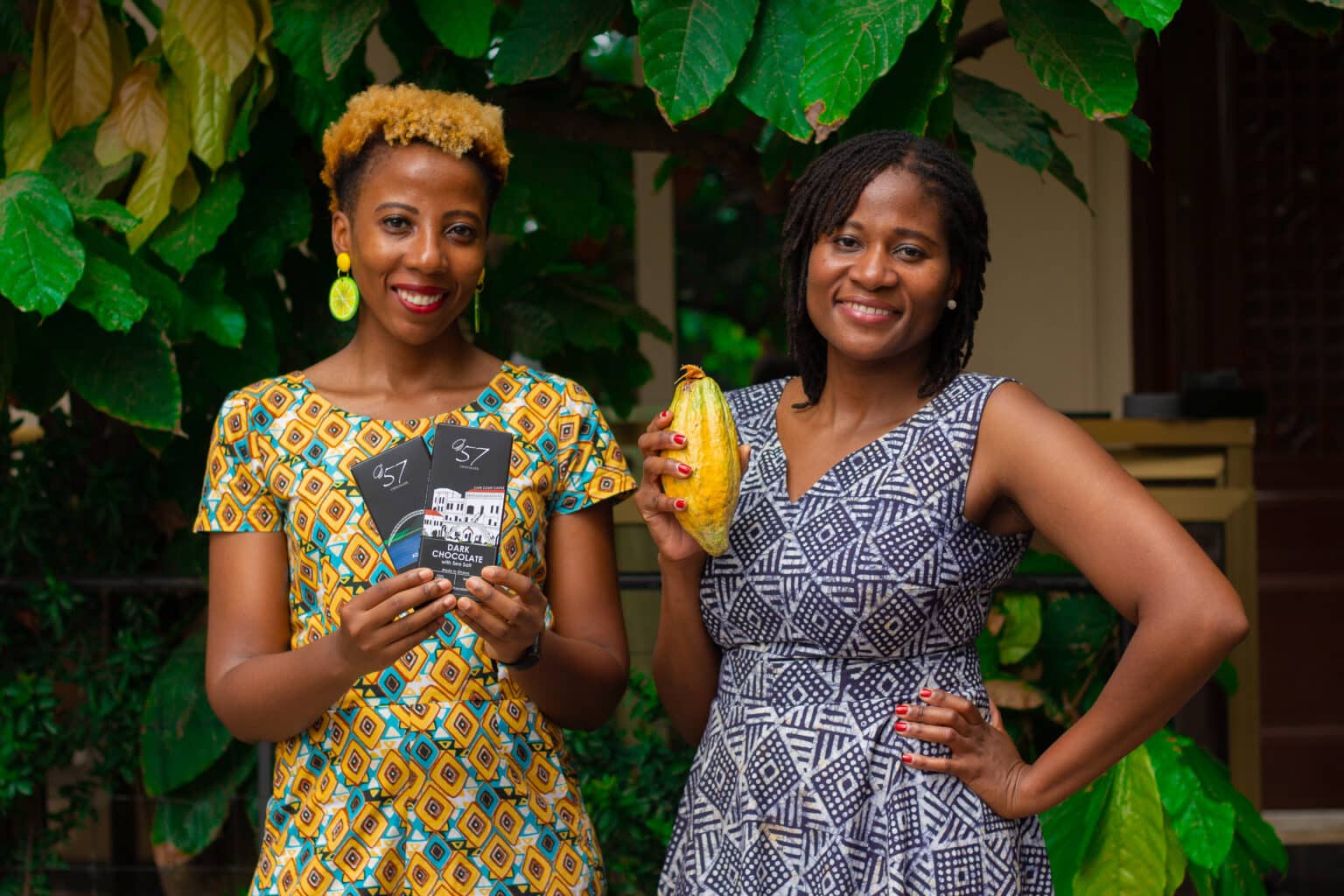
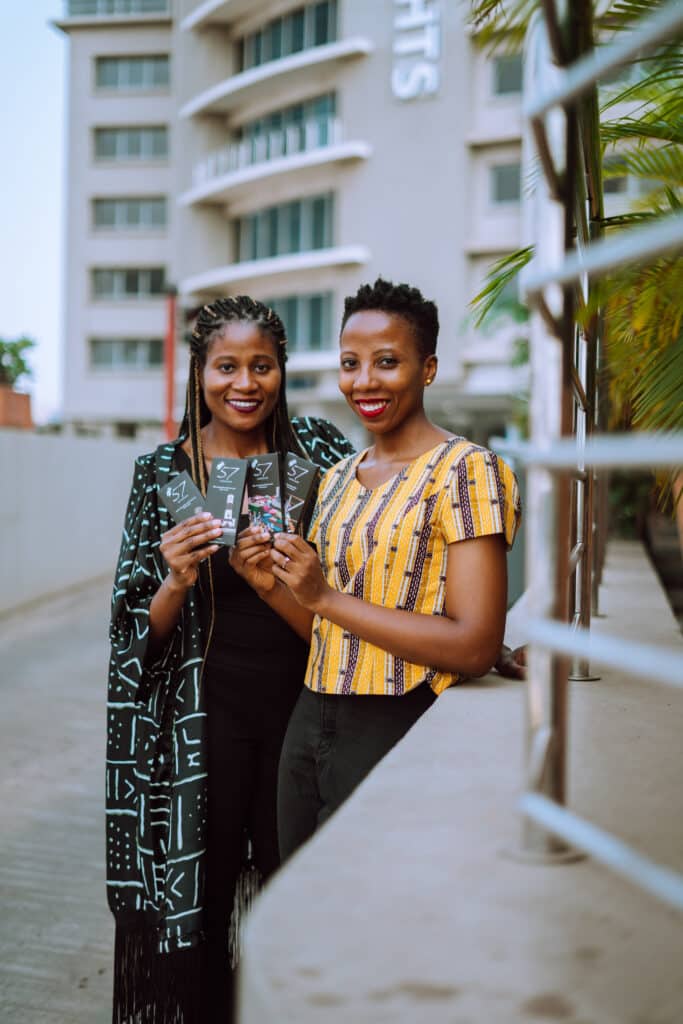
Two sisters whose lives have taken them to Africa, Europe and North America, discovered their true calling in Ghana. In 2016, Priscilla and Kimberly Addison took a chance on becoming entrepreneurs in their parents’ native land with the launch of ’57 Chocolate, the country’s first bean-to-bar company.
“We both knew we wanted to start a business. I don’t think we knew immediately that it was going to be chocolate,” says Priscilla, co-founder of ’57 Chocolate. “Kim ended up going somewhere she was invited by friends, and it triggered the idea for the chocolate business.”
From Concept to ’57 Chocolate
Born in Oklahoma, Kim was living in Switzerland when she went to a chocolate factory and made a startling discovery about where most of the cocoa beans the world consumes are grown. “At the first part of the tour, there is a display of where they source all of their beans. To my surprise, the two largest displays were Côte d’Ivoire and Ghana.
To realize that the raw materials were coming from the continent and not even from Switzerland was a big shocker,” shares Kimberly. She returned to Geneva to be near her parents when she first learned that West Africa produces more than 70% of the world’s cocoa. Côte d’Ivoire and Ghana contribute about half of that supply.
After the factory visit in 2014, she spoke with her father about his retirement plans. “He was like, ‘I’ll be retiring in a few years and moving back to Ghana with your mom. You guys should think about moving back and starting a business,’” she recalls.
By the time their father retired, the sister duo had jobs they were willing to leave. Both had double majors in French and International Studies, Kimberly from Boston College and Priscilla from Dickinson College in Pennsylvania. Neither had any experience with starting a business or making chocolate. Still, they loved chocolate as kids and tried chocolate brands available in Switzerland.
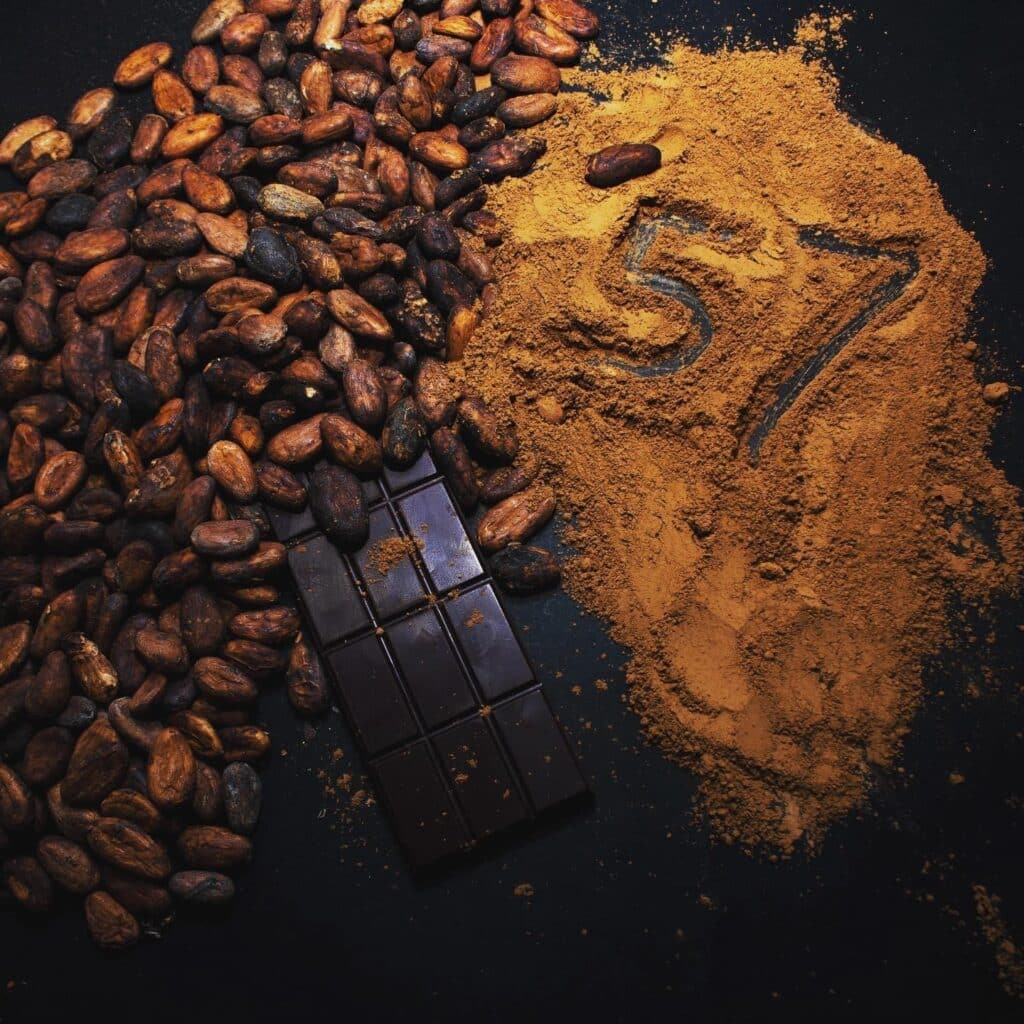
“We were buying chocolate on the shelves, trying different things, different truffles. That’s where my interest really peaked in chocolate, because essentially we were in the land of chocolate,” Priscilla remembers.
Kimberly’s visit to the Swiss chocolate factory ignited a deeper interest. “I’m a firm believer in God, praying and asking for a business idea. I remember taking some beans from the display and going home to Priscilla and saying, ‘This is what we should do.”
“Kim is very much a chocolate lover, and I think we both wanted to do something powerful for our country. So, I think it definitely lit a light bulb in both of our heads,” Priscilla adds.
With Kimberly moving to Ghana once her father retired, the Addison sisters poured their savings into their business, creating a luxury chocolate brand made in Ghana from organic cocoa beans. A grant and support from family and friends helped launch ’57 Chocolate in East Legon, a suburb in the Accra Metropolitan District.
“When we first started the chocolate business in 2016, Kim and I would go grocery shopping often. We rarely saw any made-in-Ghana chocolate bars. It was all foreign-made brands,” says Priscilla. She and her sister recognized how making chocolate in Ghana could add value to one of the country’s major resources, cocoa beans.
Tasting Ghana in ’57 Chocolate
The ’57 Chocolate’s owners set out to accomplish far more than give the world another sugary treat. The sisters built a company that introduces the tastes of Ghana and Africa to chocolate lovers worldwide.
“We want people to taste and savor Ghana’s rich cocoa. We’re the second largest producer of cocoa, so we want the cocoa to shine in our chocolate bars. There are no additives, preservatives or any ingredients that are hard to pronounce,” Priscilla declares, the Ghanaian company’s brand and marketing executive, who was born in Ghana and now lives in Virginia. There, she focuses on getting ’57 Chocolate’s products to customers. The small batch, artisanal chocolate bars and chips are sold online and most of the buyers are in the U.S.
“Before our ecommerce site, we would ship directly from Ghana. Now customers can buy directly from our ’57 Chocolate U.S. website,” Priscilla remarks.
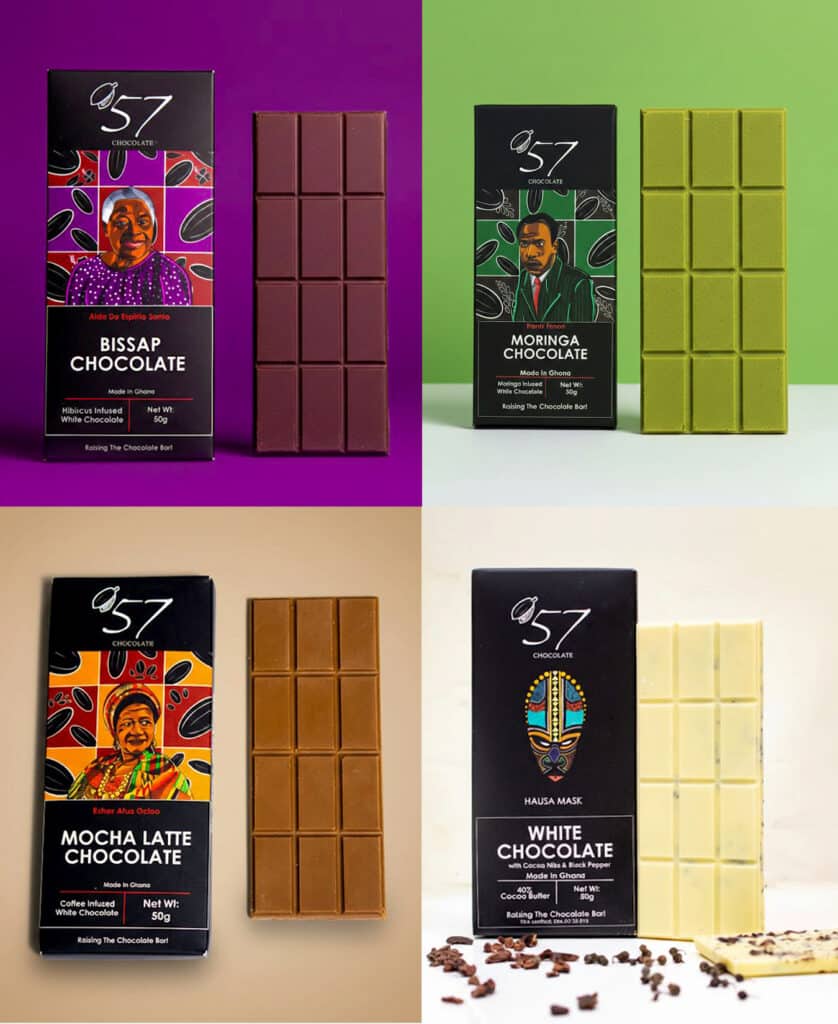
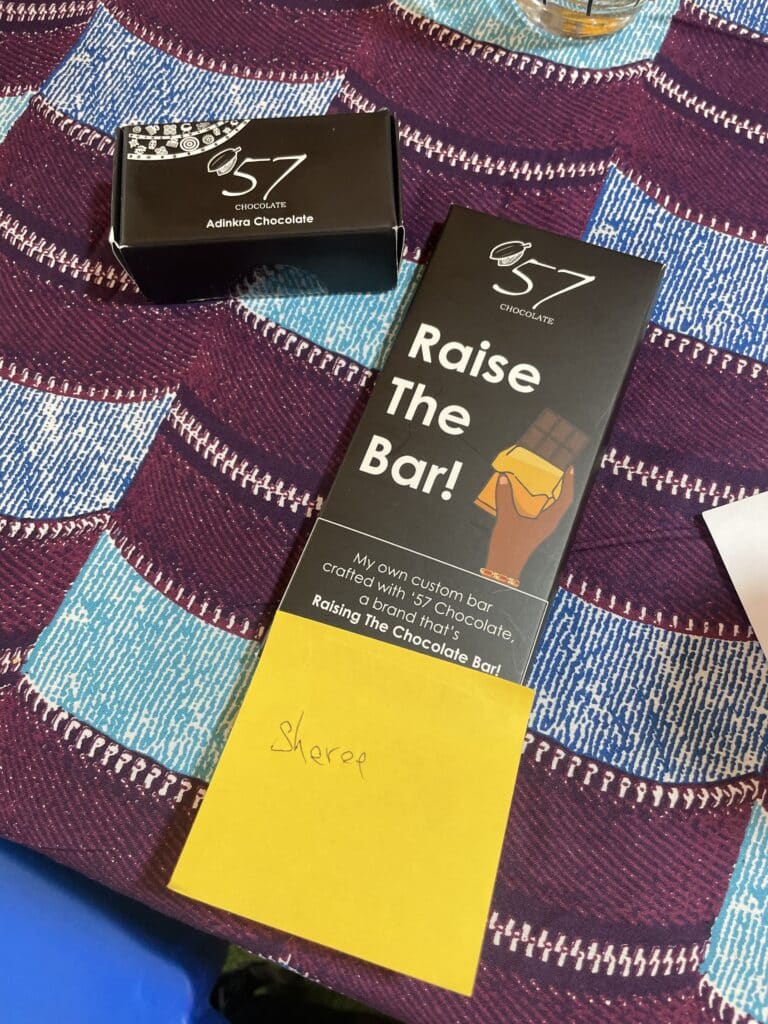
Customers can do more than taste Ghana’s premium organic cocoa in every bite of ’57 Chocolate. The Addison sisters also introduce African art and culture to their buyers. The Adinkra Collection offers bite-size chocolate bars engraved with 12 symbols designed by the Akan people to represent leadership, strength and other concepts.
“Each Adinkra symbol has a unique meaning in Ghana,” says Priscilla. “For example, there is one that looks like a comb. It is a symbol of femininity and beauty. That’s one of my favorite symbols.”
’57 Chocolate’s Bogolan Collection also has engraved symbols representing the artistry of mud cloth from Mali. All of the chocolates and confections sold in boxes, bars and chips by the Ghanaian company come in a variety of flavors, including dark, milk, white and vegan.
Kimberly describes the qualities of the classic dark chocolate. “This chocolate has won many milk chocolate lovers over to the dark side because it is mild and inviting. Priscilla and I were very intentional when we created this recipe. At the time, we were still growing fans of dark chocolate, so we wanted to create a dark chocolate that even milk chocolate lovers would appreciate.”
Kimberly oversees the day-to-day operations of ’57 Chocolate’s shop in Ghana, from production to development and packaging with 20 employees. She points out that some of their flavor and ingredient choices reflect their experiences living in different countries.
“Bissap is a drink commonly found in West Africa. It has hibiscus petals and different spices. We grew up drinking that in Senegal, so we decided to create a bar inspired by bissap. And then we have moringa-flavored chocolate. It is known as a miracle tree. Its leaves are very herbal and medicinal. We wanted to feature this taste because many people cook with moringa. They put it in their soups and stews and also use it as a tea.”
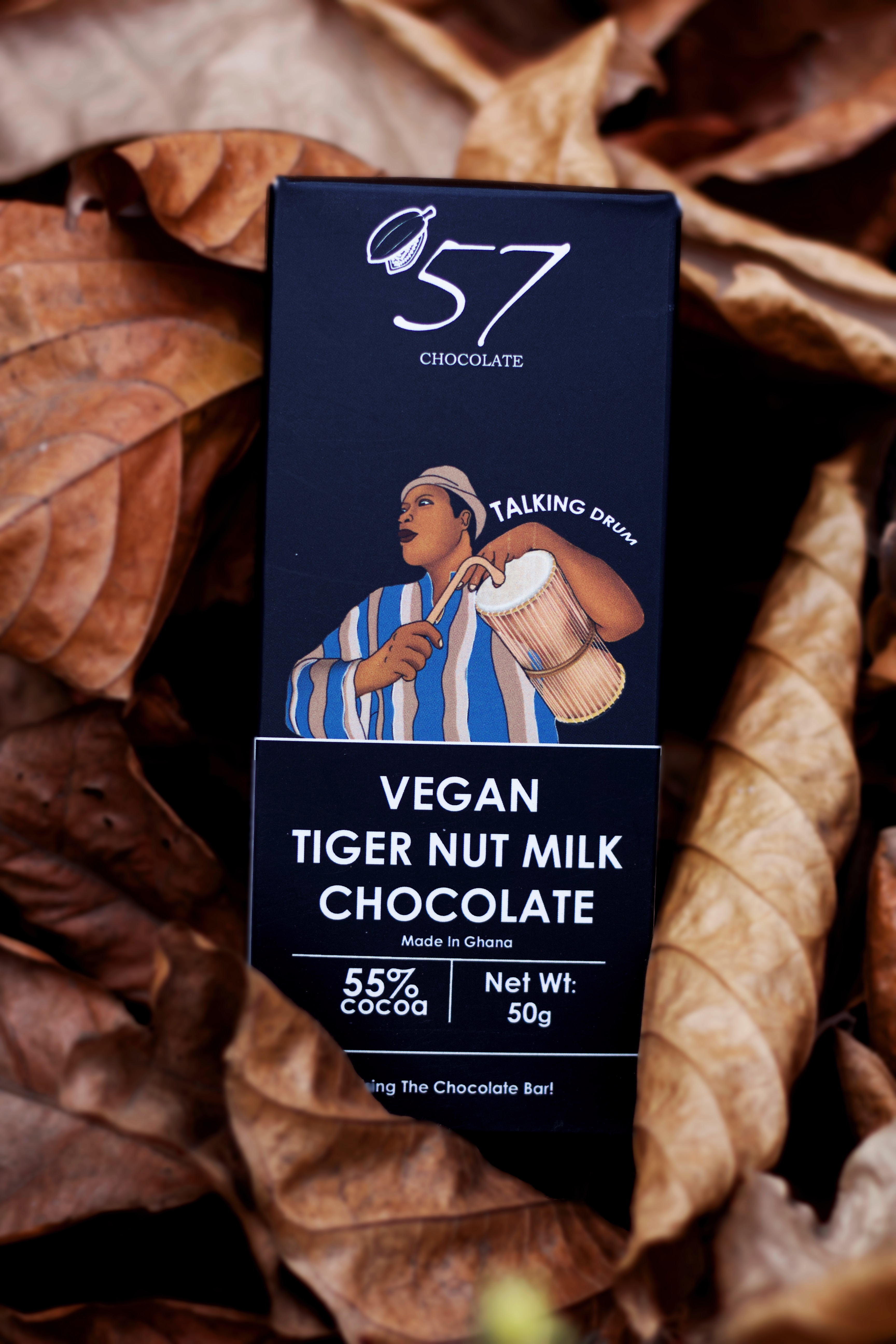
Customers can order the company’s chocolate with other ingredients, such as almonds, coffee, tiger nut, coconut, ginger and sea salt. “It’s always fun to cater to people’s different palates. Chocolate is something I would say is emotional and goes with your mood. Sometimes, you might be looking for comfort. I would say our most comforting and warm bar is our milk chocolate with almonds and sea salt,” Kimberly suggests.
’57 Chocolate produces such a variety of flavors because the sisters want to take people on a journey into Africa. Priscilla explains how the company’s packaging contributes to the cultural adventure.
“We take our time to try to feature landmarks from across Ghana and things we are really proud of. For instance, we featured the Akosombo Dam on our chocolate bar. We featured Kakum National Park, where people can walk above the Ghanaian jungle on a kind of tightrope bridge. A lot of people tell us your packaging is so nice, we really don’t want to throw the wrapper away. It’s a work of art.”
Changing Minds with African Chocolate
While the primary reason ’57 Chocolate exists is to sell top-quality products made in Ghana from mostly local ingredients, the Addison sisters are also committed to changing minds about Ghana and other countries on the continent.
“Our desire is not just to make Ghana known for chocolate, but also to change the narrative of what it means to be made in Africa,” Kimberly states. “Oftentimes, when people talk about Africa or African products, there is kind of a stigma to it. People expect it to be lower quality, not as nice or not as beautiful.”
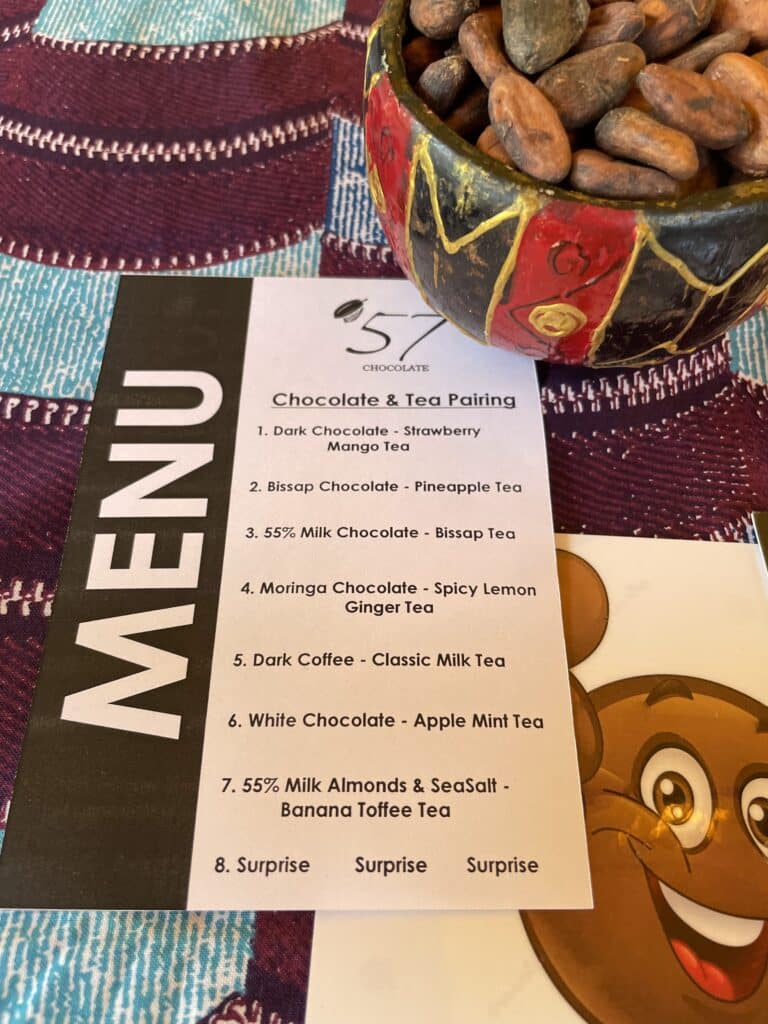
Priscilla believes she and her sister have the power to change that narrative. “We’ve been doing a lot of behavior changing since we started the company. Kim will tell you, we’ve done chocolate tastings with kids. They are completely flabbergasted that the ’57 Chocolate they’ve tasted is made in Ghana.
The Addisons are shifting biased beliefs about African products through their artisanal chocolates, unique flavors and package storytelling. Kimberly emphasizes the importance of selecting the best local sources for ’57 Chocolate’s ingredients, including organic beans from trusted Ghanaian farmers, as well as moringa and coffee from entrepreneurs like True Moringa and Kawa Moka.
“We’re very big on trying to use suppliers within the country, because at the end of the day, if we do well, they also do well. It’s growing this circular economy where everybody is thriving. That’s really the end goal to see local businesses, not only in Ghana but also across the continent, grow and thrive.”
The ecommerce shoppers buying chocolate and confections from the Addison sisters often connect to their desire to change what people think about Africa and the use of its resources.
“One key thing is having people who are eager to see Ghana use its resources and add value to it. It’s people who are very interested in consuming locally made products. When we are talking about our international clients, it’s also people who want to explore and experience what chocolate is like in Ghana,” co-founder Kimberly comments.
RELATED: Fairafric Challenges the Past While Conquering the Future of Chocolate in Ghana
Pan-African Sisters’ Chocolate Mission
To better understand how two novice chocolate makers could invest so much in their company and their country, consider this quote from Ghana’s first prime minister and president, whom Kimberly admires. “One of my favorite quotes by Kwame Nkrumah is, ‘I’m not African because I was born in Africa. I’m African because Africa was born in me.”’
The chocolate company’s creators chose a name that pays tribute to the late revolutionary Nkrumah’s Pan-African philosophies. The ’57 refers to the year Ghana gained independence from the United Kingdom. In the years that followed, Nkrumah encouraged the development of self-governed African nations.
“Ghana was the spear or pioneer for the independence movement across the continent,” says Kimberly. In the 1950s and 1960s, Ghana was highly industrious. Some industries that existed back then no longer exist today. We had tomato processing plants, rice mills, meat processing plants and a growing dairy industry. We were making glass and our own textiles.”
The owners of ’57 Chocolate, who call themselves Pan-Africans, hope their entrepreneurial efforts can slow the migration of young people leaving Africa in search of greater opportunities.
“For us, ’57 Chocolate is about inspiring the youth to add value to the natural resources at home by creating businesses and empowering others to do the same. We’re hoping our story will inspire others across the continent to find what is most unique about their country and resources and add value to it,” Priscilla offers.
Kimberly details how ’57 Chocolate is investing in human capital and promoting a “can-do” spirit by hiring and training employees with a range of educational backgrounds, from no schooling to college degrees.
“We are very big on investing in young people and helping them build skills. Our goal is that they should leave better than they came.”
To Kimberly, that means helping youth dream and think about the businesses they could start. “When people decide to stay, take up the challenge of entrepreneurship and add value to our local resources, they will also grow the economy. Hopefully, we will eventually achieve economic independence and no longer rely on other countries to feed Africa’s people.”
Challenges Making Ghanaian Chocolate
Naturally, starting a business anywhere comes with challenges. Priscilla explains why logistics and shipping are among the biggest hurdles in Africa. “A lot of African countries don’t own airlines, so they rely on foreign countries to ship products. The expense tends to be quite high for customers who want our chocolate in the U.K., Kenya or South Africa.
In fact, the circuitous route the company’s global shipping takes is astonishing. “If we’re shipping something to another country in Africa, often it will have to go to Europe before it comes back to the continent. I would say that the environment is so challenging that it is not always set up for businesses to succeed,” Kimberly admits.
’57 Chocolate’s founders also have to deal with high tariffs and taxes, sometimes doubling the cost of equipment. Ghana’s reliance on imported goods and lack of manufacturing capacity mean the company has to use imported milk powder and sugar.
Then there is coping with what Ghanaians call dumsor – the power outages. Kimberly acknowledges they are less frequent than when the company launched a decade ago, but they still have an impact. “We’re making a climate-sensitive product in a very hot environment. That means we have to have air conditioning running and lots of fridges to keep our products cooled, safe and well tempered, so electricity costs are extremely high.”
Other factors that could impact Ghanaian chocolate brands in the future are skyrocketing cocoa prices and dwindling farms. “There’s the issue of the next generation of cocoa farmers not existing because young people are not interested in farming. Cocoa prices have soared due to shortages,” Kimberly says.
Cultivating New Ideas for ’57 Chocolate
Nevertheless, the Addison sisters are looking to the future with plans to grow their brand. Kimberly sees ’57 Chocolate owning farms someday and becoming a tree-to-bar business. “We’re looking to invest in farming communities. That’s one of our key goals, in terms of education, especially for the younger generation.”
The vision Kimberly describes is using farm investment and ownership to teach young Ghanaians how to run a profitable agribusiness. “For me, I don’t want young people to just start farming. I want them to think about what they are growing and how they can scale it up. How can they add value to local resources, because then you are creating jobs within jobs.”
The future for ’57 could also lead to a state-of-the-art chocolate factory and a baked goods product line. But for now, what the Addison sisters have already accomplished impresses their parents. “We’re very blessed to have our parents,” says Kimberly. “They’ve been a part of that journey, encouraging, advising and supporting us. We’re very happy that we’ve made them proud, and we hope to continue to make them proud.”
That said, ’57 Chocolate’s co-owners are also glad to see other chocolatiers in Africa thrive. They consider the Ghanaian chocolatiers behind fairafric Ghana and Midunu, featured in two earlier Cuisine Noir articles, as colleagues and friends. So, having Taste Atlas name fairafric’s 70% Dark Chocolate & Cocoa Nibs the #1 bar in Ghana and ’57 Chocolate’s Adrinka bars #2 is a win-win for both companies.
“People will say they are our competition, but we like to see ourselves as collaborators,” Kimberly concludes. “If someone has a good experience at Midunu, they’ll be more curious and wonder what other chocolates are in Ghana and end up finding ’57 Chocolate or fairafric. It is in all of our interests for all of us to do well.”
Priscilla reinforces the sisters’ Pan-African commitment to supporting the success of other African entrepreneurs. “We are trying to get people to understand, not only on the African continent but worldwide, that products made in Ghana and Africa can be high quality too.”